



District 40 Committees
Open Service Positions
District 40 has the following open service positions below.
If you are interested, please contact the DCM (District Committee Member) for additional information.
| Committee | Open Position | Description |
|---|---|---|
| Webmaster | Alt Webmaster | The Alternate Webmaster supports the maintenance, security, and Tradition-compliant content of the District 40 website, ensuring reliable digital access to meeting information and resources for the local A.A. community. |
| Public Information | Alternate Chair | Alt to carry the A.A. message to the outside community through such as outlets as libraries, schools, churches, etc. |
| Treatment | Alt Treatment Chair | The Alternate Treatment Chair supports District 40's outreach by coordinating meeting schedules, managing "Bridging the Gap" connections, and ensuring AA literature reaches individuals in hospitals and rehabilitation facilities. |
| Grapevine | Alt Grapevine Chair | The Alternate Grapevine Chair for District 40 supports the Chairperson in promoting The Grapevine and La Viña magazines, managing outreach and displays, and preparing to transition into the primary leadership role. |
| Corrections | Alt Corrections Chair | The Alternate Corrections Chair supports District 40 by coordinating volunteer outreach, distributing literature, and ensuring administrative continuity in carrying the AA message to incarcerated individuals and helping them transition back into the community. |
| Bridging the Gap | Alt Bridging the Gap Chair | The Alternate Bridging the Gap (BTG) position supports the District 40 Chair in coordinating temporary contacts for individuals transitioning from correctional or treatment facilities into the local AA community through volunteer matching, outreach, and group education. |
| Bridging the Gap | Bridging the Gap Chair | District 40’s Bridging the Gap service connects individuals transitioning from treatment or correctional facilities to the local AA community by providing temporary contacts who guide them to their first meetings during those critical initial days of release. |
| Archives | Alt Archives Chair | The Alternate Archives Chair for District 40 supports the preservation of local AA history by assisting in the collection of records, coordinating with home groups, and maintaining historical displays for the Northwest DuPage County area. |
| Answering Service | Alt Answering Service Chair | The Alternate Answering Service Chair for District 40 supports the maintenance of the local AA hotline by coordinating volunteers, ensuring accurate meeting information, and providing administrative backup to ensure the hand of AA is always available to those seeking help. |
| Accessibilities | Accessibilities Chair | The District 40 Accessibilities Chair ensures the AA message remains reachable for all by removing physical, mental, and geographic barriers through specialized literature, meeting accessibility surveys, and coordinated support for homebound or impaired members. |
| Accessibilities | Alt Accessibilities Chair | The Alternate Accessibilities Chair is a supportive service leadership role dedicated to removing barriers to the A.A. message by assisting with disability outreach, resource management, and digital inclusivity within District 40. |
| Local Committee Member | Glen Ellyn/North/West/Wheaton | To carry the message of the District and its available services to those meetings and groups that do not have a G.S.R. |
| Literature | Alternate Literature Chair | Inform group members, through displays and other suitable methods, of all available Conference-approved literature, audiovisual material and other special items. |
| Newsletter | Alt Newsletter Chair | Produce and distribute the district newsletter publication, four times a year. |
| Public Information | Public Information Chair | To carry the A.A. message to the outside community through such as outlets as libraries, schools, churches, etc. |
Committee Information
Accessibilities

While there are no special A.A. members, some members need special help to receive the A.A. message. For the purpose of these Guidelines, we define A.A.s with special needs as persons who are blind or visually impaired; deaf or hard of hearing; chronically ill or homebound, those who are developmentally disabled, and many others who may have less visible challenges.
A.A. Guidelines – Serving Alcoholics with Special Needs
Illinois District 43 has posted under a section titled “Groupvine” (at the top of the home page), a subsection (scroll down) titled “Sober Hands” which has ASL videos (signed videos) for the deaf and hard of hearing that includes the AA preamble; 3rd Step Prayer; 7th Step Prayer; 9th Step Promises; A Vision For You; Serenity Prayer; St. Francis Prayer; The Twelve Traditions; and the Responsibility Statement. Also, under “Groupvine” there is another subsection (again scroll down) titled “Many Voices” which has recordings of the meeting literature signed in “Sober Hands” and read aloud for the blind or those with eyesight problems or those that have difficulty reading.
There is also a website that provides access to ASL online meetings. The website is located at https://doda.omnijoin.com. At this website, a list of ASL AA online meetings can be found. After clicking on the chosen meeting one is redirected to instructions as to how to access the meeting.
GSO announced in November 2019, the revised ASL editions of the Big Book and Twelve Steps and Twelve Traditions.
Answering Service

An A.A. answering service offers a local gateway to reach Alcoholics Anonymous. The service receives inquiries from those seeking help and may refer callers to a nearby A.A. group or may have a twelfth stepper contact them.
In the past, the A.A. answering service provided a listing for Alcoholics Anonymous in the local telephone directory. As technology has changed, A.A. members providing this service have found new avenues for problem drinkers seeking help to find A.A. – for example, getting the answering service number listed online with A.A. websites, Internet directories and local community websites.
Contact Answering Service Chair
Archives

Like any other A.A. service, the primary purpose of those involved in archival work is to carry the message of Alcoholics Anonymous. Archives service work is more than mere custodial activity; it is the means by which we collect, preserve, and share the rich and meaningful heritage of our Fellowship. It is by the collection and sharing of these important historical elements that our collective gratitude for Alcoholics Anonymous is deepened.
Add your group’s history with Area 20’s Group History Project
Bridging The Gap

Part of Bridging the Gap between a treatment program and A.A. is the Temporary Contact Program, which is designed to help the alcoholic in an alcoholism treatment program make that transition. As you know, one of the more “slippery” places in the journey to sobriety is between the door of the facility and the nearest A.A. group or meeting. Some of us can tell you that, even though we heard of A.A. in treatment, we were too fearful to go.
Cooperation with Professional Community

A.A. is considered by many professionals to be a valuable resource for alcoholics who want help. Members of the CPC committees provide information about A.A. to those who have contact with alcoholics through their profession. This group includes healthcare professionals, educators, members of the clergy, lawyers, social workers, union leaders, and industrial managers, government officials, as well as those working in the field of alcoholism. Information is provided about where we are, what we are, what we can do, and what we cannot do.
A.A. Guidelines – Cooperation with the Professional Community
Corrections

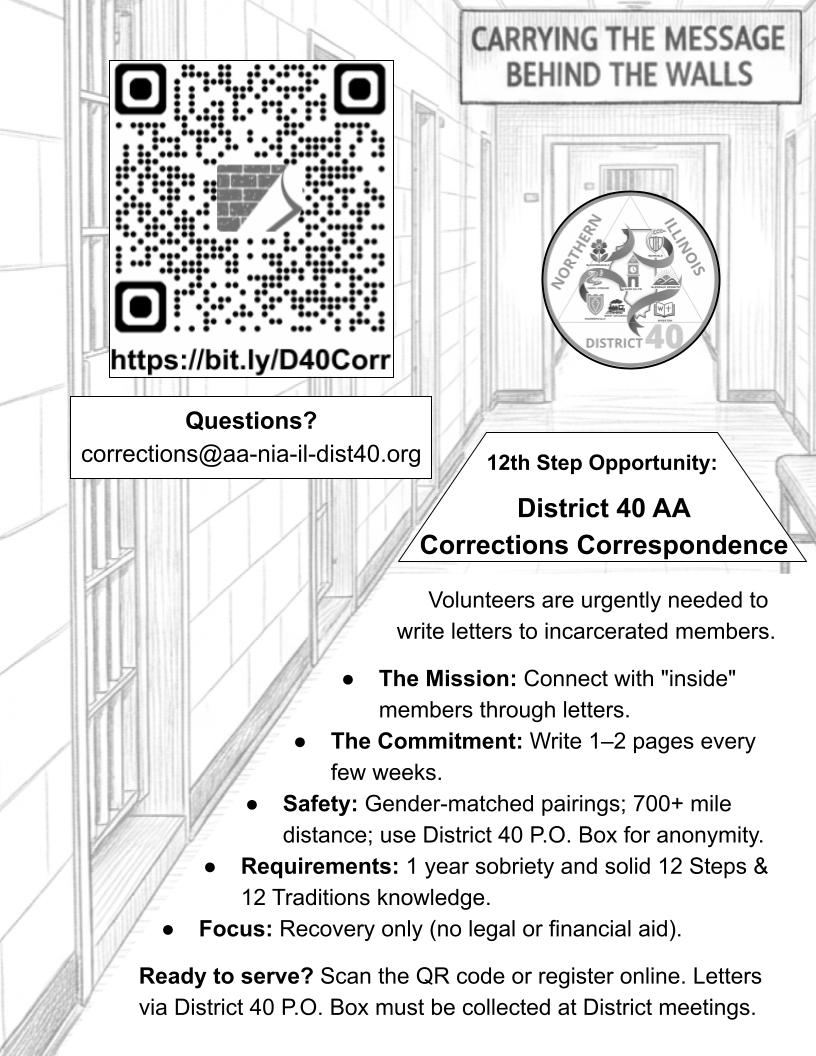
Make a difference in the life of an “inside” member by participating in a 12th Step Opportunity with District 40 AA. We are looking for volunteers to “Carry the Message Behind the Walls” by writing letters to incarcerated members who are seeking recovery.
Please read the flyer for more details on requirements—such as one year of sobriety and a focus on recovery only—and go to the link or scan the QR code to get started.

The purpose of a corrections committee is to coordinate the work of individual A.A. members and groups who are interested in carrying our message of recovery to alcoholics behind the walls, and to set up means of smoothing the way from the facility to the larger A.A. community through pre-release contacts.
The Corrections desk publishes the newsletter Sharing from Behind the Walls triennially. It contains excerpts from letters sent to GSO by persons in custody with their permission. These newsletters are for distribution to A.A. members in correctional facilities. Anyone can copy SFBTW to share with all members in the Fellowship especially those incarcerated. No permission is needed from A.A. World Services, Inc.
Grapevine
The Grapevine, “your meeting in print” is also your meeting on the Web. Why not share? We’re always accepting submissions of art or text, and you need no prior publishing experience. All it takes is a little willingness and a desire to share.
Literature

Today, as in the early days of Alcoholics Anonymous, the A.A. message of recovery from alcoholism is carried by one alcoholic talking to another. However, since the publication of the first edition of the Big Book in 1939, literature has played an important role in spreading the A.A. message and imparting information about the A.A. Twelve Step program of recovery.
A.A. co-founder Bill W., who often called the influence of A.A. literature “incalculable,” wrote in the May 1964 issue of the Grapevine, “Suppose, for instance, that during the last twenty-five years A.A. had never published any standard literature…no books, no pamphlets. We need little imagination to see that by now our message would be hopelessly garbled. Our relations with medicine and religion would have become a shambles. To alcoholics generally we would today be a joke and the public would have thought us a riddle. Without its literature, A.A. would certainly have bogged down in a welter of controversy and disunity.”
The Language of the Heart, (p. 348) Bill’s words ring just as true today. The newcomer, walking into an A.A. group for the first time, may be given a meeting list, basic recovery pamphlets and, depending on the individual group conscience, perhaps a copy of Living Sober or the Big Book.
News

Doings is a quarterly news bulletin from District 40. This newsletter includes information about A.A. service, literature, events, sharing from groups, service committees and individual A.A. members.
Public Information Service

Like all of A.A., the primary purpose of members involved with public information service is to carry the A.A. message to the alcoholic who still suffers. Working together, members of local Public Information committees convey A.A. information to the general public, including the media.
For those who want a Big Book, but only want to borrow one – copies are available at the following Public Libraries within District 40. A.A. Guidelines – Public Information
Treatment
In trying to reach the alcoholic who is in an inpatient or outpatient treatment setting, A.A.s work together, insofar as possible, by using suggestions from those who have had experience carrying the message into these settings. These Guidelines provide a summary of that shared experience. A Treatment Committee Workbook, available from the General Service Office, contains detailed information about carrying the message into treatment and outpatient settings, including ways to approach treatment personnel, presentations and workshops, temporary contact programs, and other helpful information.
Website

Modern communication in A.A. is flowing from one alcoholic to another in ways that are high-tech, relatively open-ended and evolving quickly. Protecting anonymity is a major concern for members, who are accessing the Internet in ever-growing numbers. When we use digital media, we are responsible for our own anonymity and protect that of others. When we post, text, or blog, we should consider whether we are publishing at the public level. When we break our anonymity in these forums, we may inadvertently break the anonymity of others.
A Note from your Web Administrator:
This website has been developed to be a tool for District 40 committee members and all AA members alike.
How to submit your own flyer or information to add the District 40 Calendar Click HERE
Questions and Concerns:
Please e-mail me:
– If you have questions or comments about the website
– If you have recently assumed a position and need to correct an e-mail address
– If you have any other website-related issues
 English
  Spanish